Five Questions to Ask Before Anything Beauty Lands in Your Cart

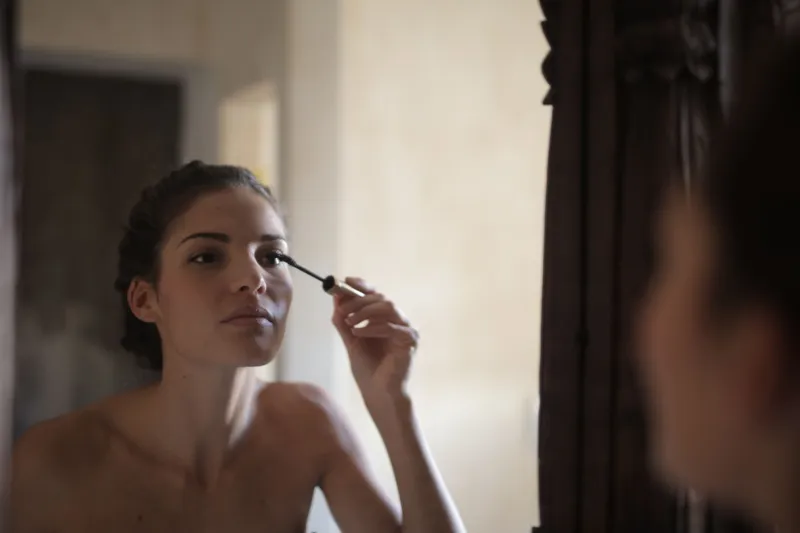
Photo: woman considering skincare product in bathroom mirror thoughtful, via c8.alamy.com
Somewhere in your bathroom, right now, there is a product you bought with total confidence and used exactly twice.
I am not judging it. Most of us have one. Mine was a cream highlighter that looked incredible under store lighting and turned me into a lighthouse by 10 a.m. It was not a bad product. It was a bad decision, made in eleven seconds at a register while a cashier scanned something else.
The interesting thing is that a salon consultation would have caught it. Not because stylists have secret knowledge, but because they ask questions before reaching for a bottle. At home, we tend to skip the questions entirely and go straight to the checkout page. That gap is where the clutter lives.
So here is the case for treating your bathroom as a consultation room. Not a store. A room where you ask yourself things before you buy.
Why the Pause Actually Works
Beauty purchases are rarely about need. They are about a feeling — the sense that your routine is somehow incomplete, that everyone else has figured something out, that the glowing review in your feed described a version of your life you would like to have.
None of that is shameful. It is just a signal that the decision is emotional, and emotional decisions benefit from a speed bump. Ninety seconds of questioning will not stop every purchase. It will stop the ones that were never really going to work.
Question One: Where in My Routine Does This Live?
Not where in the category. Where in the actual minute-by-minute sequence of your morning.
If you cannot place the product at a specific step — after serum, before sunscreen, between the brows and the mascara — then it is not entering your routine. It is entering your collection.
Try this: say the step out loud. If the sentence feels clunky or hypothetical, that is your answer. A product that needs a routine built around it is a much bigger commitment than the price tag suggests.
Question Two: What Does This Cost Per Use?
Not per unit. Per use, and per realistic use.
The math is unglamorous and clarifying. A thirty-dollar blush used four times a week for two years is pennies. A sixty-dollar serum used twice before it loses its shine — and they always lose their shine — is the most expensive thing in your cabinet.
There is a second layer here too. If a product requires a companion product to work properly (a primer that only functions with one foundation, a tool that needs a costly filter), the true cost is not what you see on the price tag. Divide by uses, then add the accessories.
Question Three: Who Is Doing the Maintenance?
This question matters most for tools, and it is the one people skip.
A device that needs daily cleaning, a battery charge, a replacement head, or a quarterly descale is not a purchase. It is a subscription to a chore, and you are the maintenance department. That is fine if you genuinely like the ritual. It is not fine if you already resent cleaning your flat iron.
Before upgrading a tool, ask how many times you reached for your current one in the last month. If the honest number is low, the problem is not the tool.
Question Four: How Many Weekday Minutes Does This Really Add?
Read the reviews with the timeline in mind. Anything marketed as an upgrade to a routine is secretly asking for more time from the only window that is genuinely scarce.
A multi-step glossing routine described as twenty minutes in the video is often forty with the sectioning, the waiting, and the cleanup. That is not a reason to avoid it — a Sunday project can be a joy. It is a reason to stop pretending it will happen on a Tuesday before a commute.
Question Five: What Am I Removing?
This is the question that keeps the bathroom from filling up, and it is the one almost nobody asks.
One in, one out. If you are buying a new moisturizer, name the one it replaces. If you are not replacing anything, ask whether you are actually adding a step you will keep or simply adding a bottle.
The answer can be yes. Just make it a spoken answer rather than an assumption.
The Three Shopper Scenarios
The impulse buy at checkout. A mini hand cream, a lip oil, a travel-size serum. The price is low enough that the questions feel silly. They are not. Ask question one only: where does this live? If the answer is in a bag you never carry, put it back.
The dupe temptation. A cheaper version of the thing everyone loves is not automatically a win. Ask question one and question three together. Formulas vary. If the dupe requires extra steps or a supporting product to behave like the original, the savings evaporate quickly — and you have bought two decisions instead of one.
The tool upgrade. The big one. Ask question three and question four, in that order. Devices are the highest-conviction purchases in beauty and the most frequently abandoned. If your current tool is genuinely failing, upgrade. If the only thing failing is your motivation, the new tool will not fix it, and you already know that.
The Checklist, If You Want to Screenshot It
- Which minute of my morning does this belong to?
- What is the cost per realistic use?
- What maintenance does it demand, and who does it?
- How many weekday minutes does it add, honestly?
- What am I replacing or removing?
Five questions. No more than a minute and a half. If a product survives all five, buy it and enjoy it — no guilt, no second-guessing.
The goal is not to buy less for the sake of a smaller shelf. It is to end up with a bathroom where everything in it is something you actually reach for. That is the more confident version of a collection, and it is a much nicer room to start your morning in.